


How LEI and vLEI Fit into the Next Generation of Capital Markets
Europe is preparing for a new generation of financial markets. Bonds, shares and other securities are moving towards digital systems built on distributed ledger technology (DLT). Tokenisation aims to make transactions more efficient, speed up settlement and automate processes that currently involve several financial institutions.
DLT allows multiple participants to share and verify records in a common digital system. Blockchain is one form of this technology. In financial markets, it can help participants exchange information and coordinate transactions with less manual work.
As these systems develop, trusted identification of the companies and other legal entities involved becomes an essential part of the infrastructure.
On 9 November 2026, the European Central Bank (ECB), the European Commission and the European Securities and Markets Authority (ESMA) announced a call for participants in the European Tokenisation Standards Group (ETSG).
The group will bring together financial industry participants to develop common standards for connected digital financial markets. Its work will focus on helping different systems exchange information, hold securities and process transactions.
One principle stands out: build on established financial market standards and adapt them to new technology.
This brings the Legal Entity Identifier (LEI) into focus.
The LEI is a globally recognised, 20-character alphanumeric code that uniquely identifies companies and other legal entities. Financial markets already use it for identification and regulatory reporting. Tokenisation creates new opportunities to integrate the LEI into digital securities infrastructure.
Tokenisation Changes the Infrastructure, Not the Company's Identity
Tokenisation represents a financial instrument, or rights linked to it, as a digital token. DLT provides a new way to record, manage and transfer these instruments.
For different platforms to work together, they need compatible data and common standards. This allows securities and related information to move between systems and supports more automated transactions.
Europe's new standardisation initiative addresses this challenge.
The official ETSG mandate includes a simple principle: “Not reinventing the wheel.” The group intends to build on established financial industry standards and existing DLT standards wherever they remain suitable.
Legal entity identification already has a global standard.
Consider a company issuing a traditional bond. The financial instrument receives an International Securities Identification Number (ISIN), while the LEI identifies the issuing company.
Now imagine the same company issuing its next bond in tokenised form. The technology for recording, holding and transferring the bond changes. The issuer remains the same legal entity, identified by the same LEI.
A blockchain address identifies a digital wallet or technical account. The LEI connects a legal entity to verified reference data, including information from official business registers.
This creates a consistent link between the company and its activities across different financial systems.
The technology behind a security can change while the issuer retains the same legal identity.
LEI and ISIN: Established Standards for Digital Markets
Discussions about tokenisation often focus on blockchain networks, smart contracts and faster settlement. Another important part of the process is how systems identify financial instruments and the organisations connected to them.
Financial markets already use two complementary standards for this purpose.
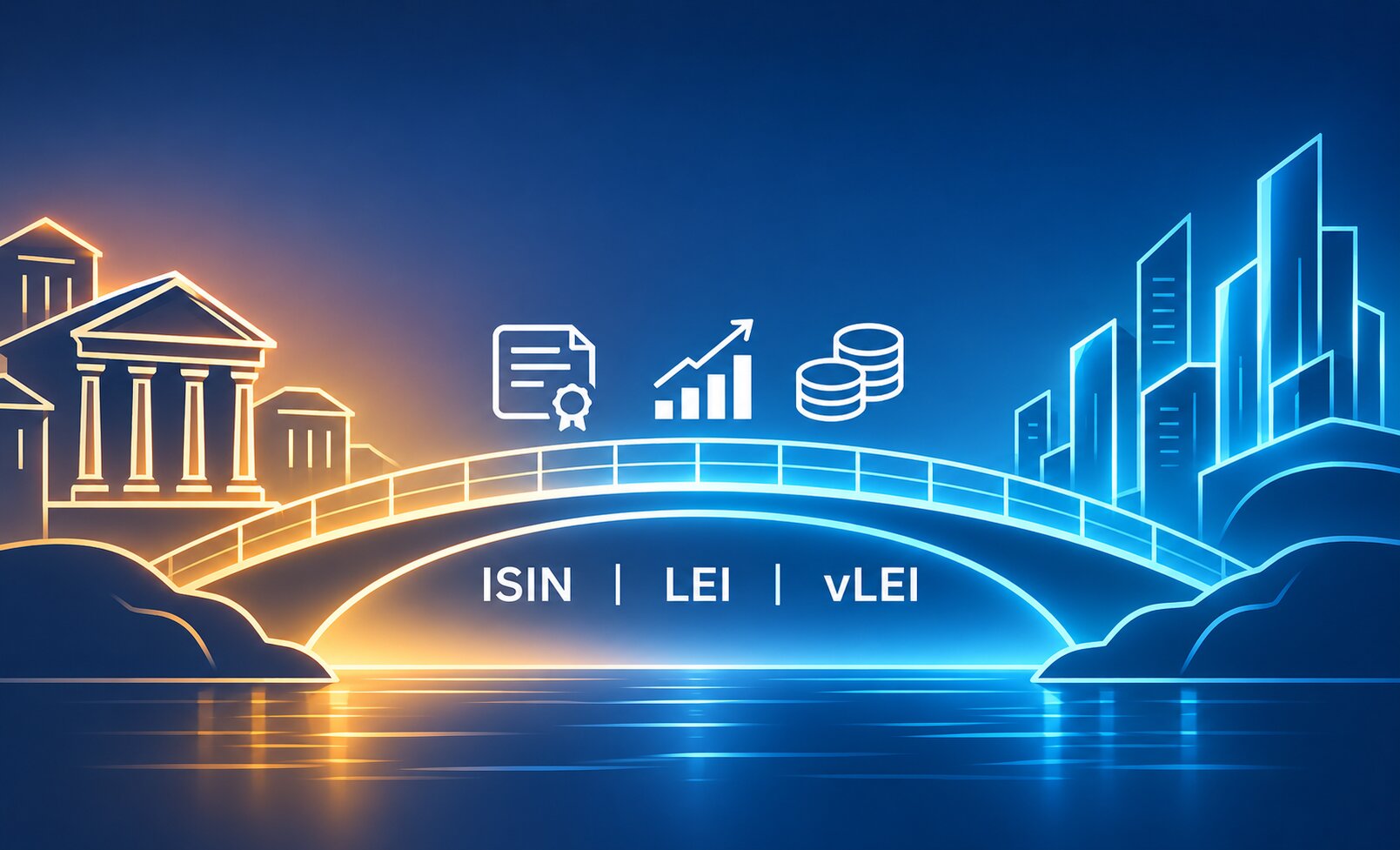
The International Securities Identification Number (ISIN) identifies a financial instrument. The Legal Entity Identifier (LEI) identifies a legal entity.
Both continue to serve their established roles in tokenised markets. Financial systems use these identifiers to recognise securities, issuers and other legal entities involved in transactions.
As markets become more automated, these identifiers will become more closely integrated with digital infrastructure.
This development also creates opportunities to connect financial data more effectively. Systems can combine existing identifiers with digital credentials, standardised data models and automated verification tools.
The next stage is therefore about making established standards work together across new financial technologies.
vLEI Brings Identity Verification into Automated Transactions
Digital financial markets need to identify the companies involved in transactions. They also need reliable ways to verify the people authorised to act on behalf of those companies.
This is where the verifiable Legal Entity Identifier (vLEI) becomes particularly relevant.
The LEI provides a unique identity for a legal entity. The vLEI extends that identity into the digital world through cryptographically verifiable credentials. These credentials can also confirm a person's organisational role and authority.
For example, a financial institution could use a vLEI-based solution to verify the identity of a company participating in a digital securities transaction. It could also check whether the person approving the transaction holds the appropriate authority.
Systems can verify these digital credentials automatically, making identity checks easier to integrate into financial workflows.
On 10 November 2026, Alexandre Kech, CEO of the Global Legal Entity Identifier Foundation (GLEIF), explored this development in his article Trusted Organizational Identity as the Common Layer for Digital Markets.
Kech describes how the LEI and vLEI can connect established financial market standards with emerging digital systems.
His analysis also draws on work by the International Capital Market Association (ICMA) and the International Securities Services Association (ISSA). Both organisations have examined the importance of consistent identification, connected data and common standards in modern financial markets.
Their work points towards a more integrated approach to financial market infrastructure. Securities data, organisational identity and digital verification can operate together across the transaction lifecycle.
As financial processes become more automated, the LEI and vLEI provide a common foundation for identifying organisations and verifying authority.
Why Europe's Initiative Matters Beyond Europe
Financial institutions are developing tokenised securities infrastructure in several markets around the world. The long-term success of these systems depends partly on how well they connect across platforms and jurisdictions.
A bond issuer, investor, intermediary and settlement provider may all operate in different countries. Common identification standards help them exchange reliable information and connect their systems.
The ECB's Appia initiative takes a broader approach to this development. It explores how Europe can build an integrated financial ecosystem using tokenisation and distributed ledger technology.
The Eurosystem aims to deliver a blueprint by 2028. It will outline key findings, recommendations and principles for future digital financial market infrastructure.
The ETSG's work on common standards supports this wider effort.
The LEI brings an important advantage to this process: global reach.
Financial institutions already use the LEI in regulatory reporting and other established market processes. The identifier works across national borders and different technology platforms.
This gives it a strong position as digital capital markets develop. A common legal entity identifier can help connect securities, issuers and transaction participants across traditional and tokenised systems.
For businesses operating internationally, consistent identification also supports smoother information exchange between financial institutions and market infrastructures.
Trusted Identity as Part of Future Capital Markets
Europe's tokenisation initiative marks another step towards more connected digital capital markets. New technologies are bringing securities issuance, custody, trading and settlement into increasingly automated environments.
Trusted legal entity identification will remain central to these processes.
The LEI already provides a globally recognised standard for identifying companies and other legal entities. The vLEI extends this foundation by enabling digital verification of organisational identity and authority.
Together, they offer a practical way to connect established financial market standards with emerging digital infrastructure.
At LEI System, we believe the LEI and vLEI are well positioned to become essential parts of the identity infrastructure supporting future digital capital markets.