


Every Size, Not Just Large Vendors
DORA's third-party register doesn't exempt small vendors: a SaaS company providing one service needs an LEI just like a global cloud provider does.

Select Your Jurisdiction
Currently selected: Türkiye|

Search region…
The EU's Digital Operational Resilience Act became fully applicable on 17 January 2025, and its implementing technical standards (Commission Implementing Regulation (EU) 2024/2956, Article 3(5)) require financial institutions to identify every third-party ICT service provider in a formal register using a valid, active LEI or EUID, with the LEI mandatory specifically for providers established outside the EU. If your organization provides IT, cloud, data or SaaS services to an EU financial institution, that client may already be asking for your LEI. LEI System gets ICT providers registered in minutes, backed by GLEIF accreditation and a 150-jurisdiction reach.


LEI System is an official LEI Registration Agent
Latest LEIs issued:
984500F4100AB5956011 |  QUINNCOM INTERNATIONAL PTY LTD
The requirement reaches any ICT vendor serving a regulated financial client, and relevance has nothing to do with company size.
DORA's third-party register doesn't exempt small vendors: a SaaS company providing one service needs an LEI just like a global cloud provider does.
Cloud hosting, infrastructure and platform providers serving EU financial institutions are among the ICT third parties DORA's register is built to identify.
Software vendors providing applications used in a financial institution's operations fall within DORA's third-party ICT scope, regardless of company size.
Providers of market data, analytics or data-processing services to financial clients need to be identifiable the same way any other ICT third party is under DORA.
Firms delivering ongoing IT services, support or managed infrastructure to regulated clients are typically captured by the same third-party identification requirement.
A financial institution's DORA obligation is the reason a vendor is asked for an LEI. These are the operational problems it solves along the way.
| Problem | How the LEI Solves It |
|---|---|
| A financial client can't formally register your business in their DORA third-party record | Your LEI gives them a globally recognized identifier to enter into that register |
| Internal vendor codes vary between clients and don't map to a global standard | One LEI works consistently across every client's third-party risk register |
| ICT incident reporting needs a consistent way to identify the vendor involved | The LEI supports accurate, machine-readable incident reporting to EU supervisors |
| Contractual identification requirements slow down onboarding as a new vendor | A verified LEI on file satisfies DORA's unique-identification contractual expectation upfront |
| A critical provider needs to be formally identifiable to EU supervisory authorities | The LEI is the global identity anchor DORA's oversight regime is built around |
Beyond satisfying a client's request, this is where the LEI actually gets used.
A financial institution client enters your LEI into its formal register of third-party ICT arrangements, satisfying its own DORA obligation.
Provide your LEI as part of a new contract with a regulated client, satisfying DORA's expectation that critical third parties are uniquely identifiable.
When a major ICT incident involves your organization, your client's incident report to regulators references you by LEI, not an internal vendor code.
Use the same LEI across every financial institution client's register, rather than tracking a different internal reference for each relationship.
DORA was built around a simple problem: financial institutions had no consistent way to identify the growing web of third-party ICT vendors their operations depend on, each institution tracked vendors with its own internal codes, making systemic risk across the sector impossible to see clearly.
The LEI solves that the same way it solves entity identification everywhere else, one globally recognized identifier that every financial institution's register, and every regulator's oversight system, can reference consistently.
A client's DORA obligation is the reason you're asked for an LEI. What it changes for you operationally is the reason it's worth registering promptly.
A client's DORA obligation is the reason you're asked for an LEI. What it changes for you operationally is the reason it's worth registering promptly.
Having an LEI ready when a financial institution asks removes a step from contract negotiation, instead of a back-and-forth about how they'll identify you internally.
If you serve multiple regulated clients, one LEI satisfies every one of their DORA register requirements, instead of navigating a different identification process per client.
If your services are significant enough to trigger DORA's direct supervisory oversight for critical providers, an existing LEI means you're already formally identifiable to regulators.
DORA places direct obligations on financial institutions, but those obligations translate into practical, real requirements for their ICT vendors.
Financial institutions must maintain a register of all third-party ICT providers, using a valid, active LEI or EUID for each entry, LEI is the only option for providers established outside the EU (Reg. (EU) 2024/2956, Art. 3(5)).
DORA requires institutions to report major ICT incidents to regulators, with consistent identification of the provider involved supporting accurate reporting.
DORA mandates specific contractual provisions with critical ICT providers, who must be clearly and uniquely identifiable, the role the LEI is designed to fill.
DORA introduces direct EU supervisory oversight for critical third-party ICT providers, who need a formal identity anchor for that oversight to function.
| Requirement | Applies To | Role of the LEI |
|---|---|---|
| Third-Party Risk Register | All financial institutions under DORA | Recommended identifier for each ICT provider entry |
| ICT Incident Reporting | Financial institutions reporting major incidents | Consistent identification of the provider involved |
| Contractual Provisions | Critical ICT providers | Unique identification required in contract terms |
| Supervisory Oversight | Critical third-party providers | Formal identity anchor for EU regulatory oversight |
Individual registration works if you serve one financial client. Providers serving several rarely stop there, subsidiary entities and group structures often need identifiers tracked at once.
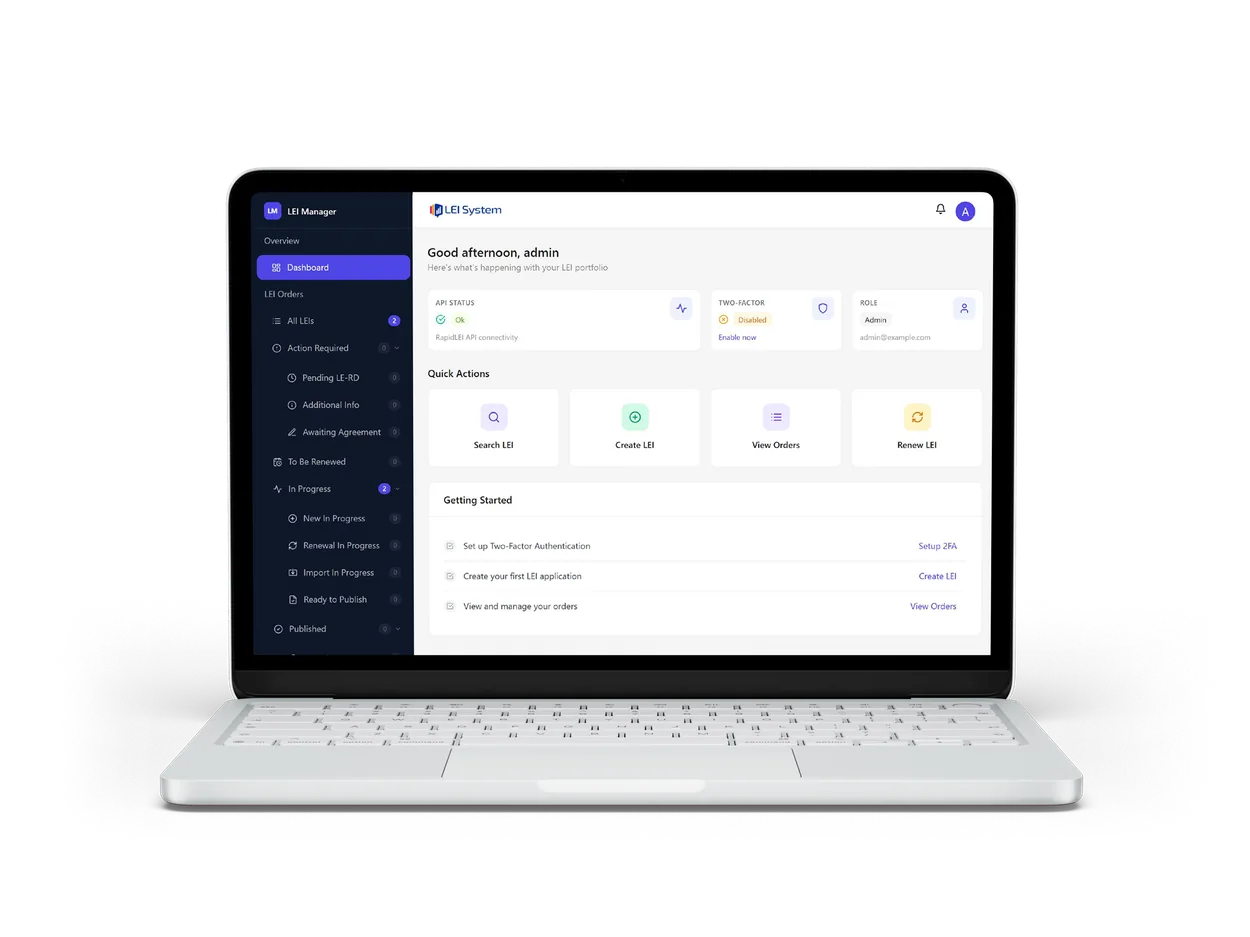
LEI Manager is LEI System's platform for exactly that.
Explore LEI ManagerTrack every LEI across your organization's entities from one dashboard, with automatic renewal so your registration never lapses out of a client's DORA register unnoticed.
Connect LEI status checks into your own vendor or subsidiary management systems via the LEI Manager API, keeping identity data current across group entities automatically.
Register LEI codes for multiple subsidiary or group entities in a single upload, useful for ICT groups with several legal entities serving different regulated clients.
Getting registered is a five-minute online process, not a paperwork exercise. Submit your entity's legal name and registration details, LEI System verifies them against official business registries, and your code is issued and published to the GLEIF Global LEI Index, immediately checkable by any counterparty or regulator who looks it up.

Pick a subscription plan and complete the online application with your entity's legal name, address and registration number.


Our system verifies your entity data against official business registries in real time, notifying if additional documents are needed.

Your LEI code is issued, recorded in the Global LEI Index and delivered to your email address along with a confirmation.
Every LEI System plan includes the GLEIF fee, lapse protection, and automatic annual renewal, so a code stays in ISSUED status for every transaction it is used in, not just the first one.

Kristian Hein, November 18
The Financial Stability Board’s 2026 cross-border payments report highlights the UK’s CHAPS system as a live example of how Legal Entity Identifiers are moving into payment infrastructure. CHAPS handles everything from time-sensitive business and property payments to large financial-market settlements. Its financial-institution layer carries 73% of the value settled, making LEI data especially relevant for risk management, compliance, counterparty identification, and automated processing.
Read more
Kristian Hein, November 11
Does a branch need its own LEI, or should it use the head office’s code? Opening a foreign branch does not automatically create a separate LEI requirement. This guide explains the difference between branches and subsidiaries, when reporting rules call for the head office’s LEI, and when a branch may need its own. Find out what to check with your bank, broker or supervisory authority before applying.
Read more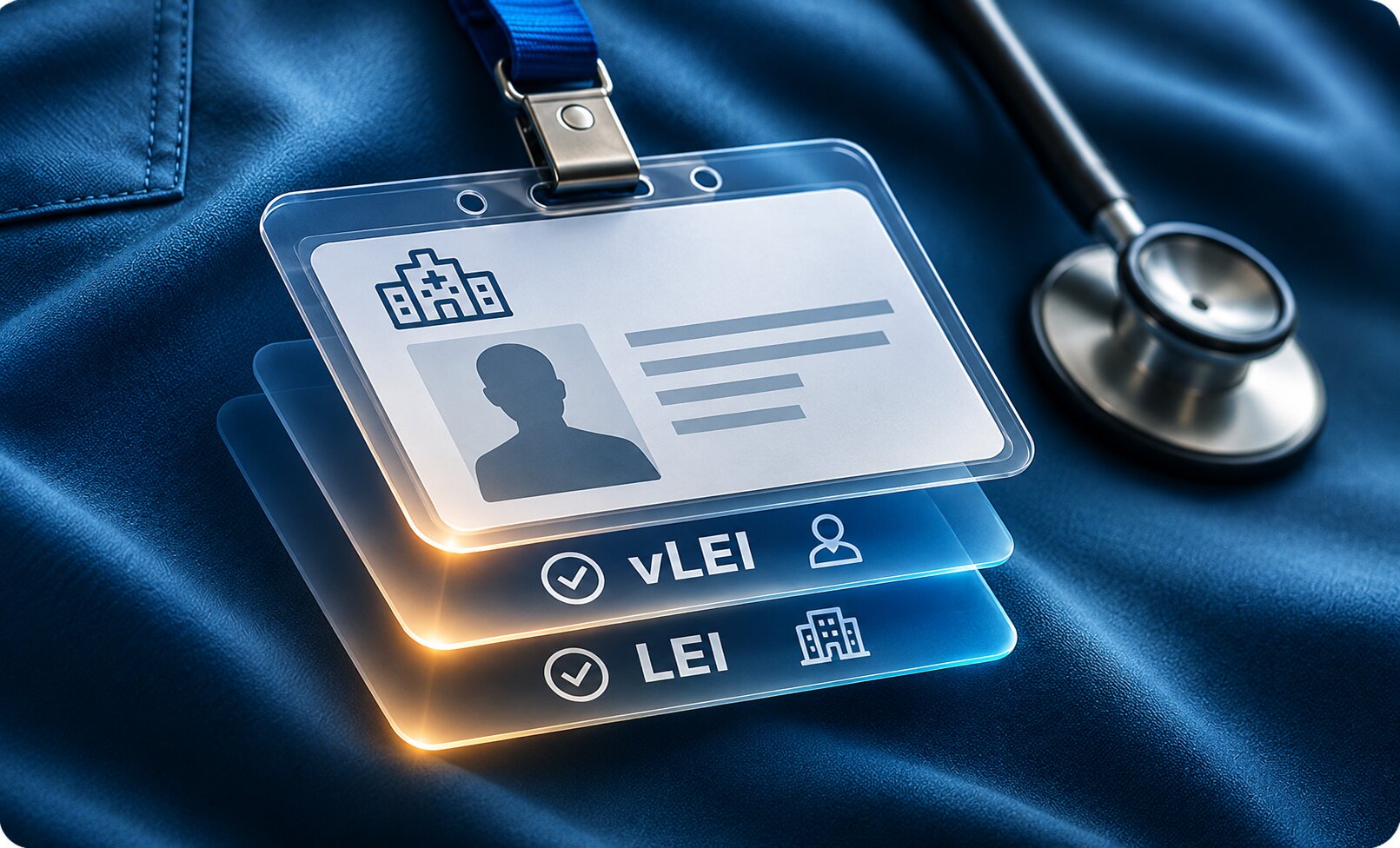
Kristian Hein, November 2
GLEIF and DirectTrust are developing a new digital trust model for US healthcare using LEI and vLEI. The initiative aims to help hospitals, laboratories, insurers, and other organizations verify identities, confirm delegated authority, and establish trust across digital systems. It marks an important step toward expanding the use of LEI beyond financial services.
Read more






 Affordable
 Lapse Guard
 Auto Renewals
 €59 total