


Every Size, Not Just Large Exchanges
A five-person token issuer authorized under MiCA needs an LEI just like a major exchange does. Startups, SMEs and large exchanges are all in scope, regardless of size.

Select Your Jurisdiction
Currently selected: Türkiye|

Search region…
Crypto-asset service providers now operate under the same entity-identification standards as traditional finance. MiCA authorization runs through ESMA's public CASP register with the LEI as its anchor identifier, the EU Transfer of Funds Regulation requires it on every CASP-to-CASP transfer, and AMLA's obliged-entity framework is built around it too. LEI System gets CASPs and crypto companies registered in minutes, backed by GLEIF accreditation and a 150-jurisdiction reach.


LEI System is an official LEI Registration Agent
Latest LEIs issued:
984500F4100AB5956011 |  QUINNCOM INTERNATIONAL PTY LTD
The requirement reaches every regulated entity in the crypto value
chain, and relevance has nothing to do with company size.
A five-person token issuer authorized under MiCA needs an LEI just like a major exchange does. Startups, SMEs and large exchanges are all in scope, regardless of size.
Exchanges, custody providers and trading platforms need an LEI for MiCA authorization and to appear correctly in ESMA's public CASP register.
Entities issuing asset-referenced or e-money tokens under MiCA need their own LEI for regulatory identification, separate from the LEIs of their counterparties.
Funds and platforms with institutional crypto counterparties use the LEI like traditional asset managers do, to identify entities cleanly across trades and transfers.
Providers holding or transferring crypto-assets on behalf of legal entity clients need an LEI to identify those clients accurately under Travel Rule transfer messages.
Regulation is the reason to register. These are the operational problems it solves along the way.
| Problem | How the LEI Solves It |
|---|---|
| MiCA authorization requires a verifiable, unique entity identifier | The LEI is the anchor identifier ESMA's CASP register is built around |
| Travel Rule transfers need a reliable originator/beneficiary identifier | One LEI resolves to one verified entity record for every CASP-to-CASP transfer |
| Sanctions screening on crypto counterparties is prone to name-matching errors | A standardized identifier removes the ambiguity screening systems misread as risk |
| Verifying a token issuer's legal identity takes manual registry work | One LEI lookup returns verified legal name, jurisdiction and status instantly |
| Beneficial ownership behind a crypto entity is hard to trace | LEI Level 2 data maps direct and ultimate parent ownership in one lookup |
Beyond satisfying a regulation, this is where the LEI actually gets used day to day.
Submit your LEI as part of a MiCA authorization application, the identifier ESMA's public register of licensed CASPs is anchored to.
Populate the originator and beneficiary identification fields in a CASP-to-CASP transfer with LEI codes where provided, satisfying TFR Article 4 with no minimum transfer threshold.
Look up an institutional counterparty's LEI to confirm legal name, jurisdiction and status before establishing a trading or custody relationship.
Screen crypto counterparties against sanctions lists using their LEI rather than a free-text name, cutting false positives caused by naming variants.
Use LEI Level 2 data to map a token issuer or exchange's ultimate parent ownership, supporting FATF Recommendation 24 beneficial-ownership requirements.
Crypto-asset regulation in the EU has deliberately converged around entity-identification standards already familiar from traditional finance, rather than invent a parallel system.
That convergence is why MiCA, the Transfer of Funds Regulation and AMLA all point to the same identifier: one verified, globally consistent LEI resolves ambiguity that a free-text company name never could, across an industry where counterparties span dozens of jurisdictions and naming conventions.
Regulatory compliance is the reason CASPs register an LEI. What it changes operationally is the reason it's worth doing properly.
Regulatory compliance is the reason CASPs register an LEI. What it changes operationally is the reason it's worth doing properly.
A verified LEI on file removes one variable from an ESMA authorization review, the entity is already unambiguously identified before any other documentation is assessed.
A verified LEI eliminates the name-variation ambiguity that generates false positives in automated screening, making it harder for bad actors to obscure identity across systems too.
With an LEI captured at institutional client onboarding, the originator data required for every qualifying transfer is already on record, no per-transaction lookup or risk of a missing identifier.
LEI Level 2 data maps direct and ultimate parent ownership globally, giving exchanges a clear view of the corporate structure behind an institutional counterparty or token issuer.
Four separate regulatory tracks have converged on the same answer, which is part of why LEI compliance in crypto isn't a passing trend.
MiCA Article 62(2)(a) requires the applicant's LEI as part of the CASP authorization application itself, and ESMA's public register of licensed CASPs uses that same identifier as its anchor.
The TFR (Regulation (EU) 2023/1113, Article 4) applies to every CASP-to-CASP transfer with no minimum threshold; for legal entity originators, the LEI is required in the identification field where one has been provided and the format supports it, alongside name and address.
All CASPs will be designated obliged entities under AMLA, with direct supervision for high-risk and cross-border platforms; LEI-anchored KYB now reduces the compliance lift later.
FATF 24 addresses transparency of legal arrangements and ownership structures, and LEI Level 2 data directly supports the beneficial-ownership identification CASPs need under AML frameworks.
| Regulation | Jurisdiction | What It Requires |
|---|---|---|
| MiCA | EU | LEI as the anchor identifier for CASP authorization |
| Transfer of Funds Regulation | EU | LEI for legal entity originators in CASP-to-CASP transfers |
| AMLA | EU | LEI-anchored KYB for obliged-entity CASP supervision |
| FATF Rec. 24 | Global | Beneficial ownership transparency via LEI Level 2 data |
Individual registration works when you need one LEI. Exchanges rarely stop at one, institutional counterparties, token issuers and subsidiary entities all need identifiers tracked at once.
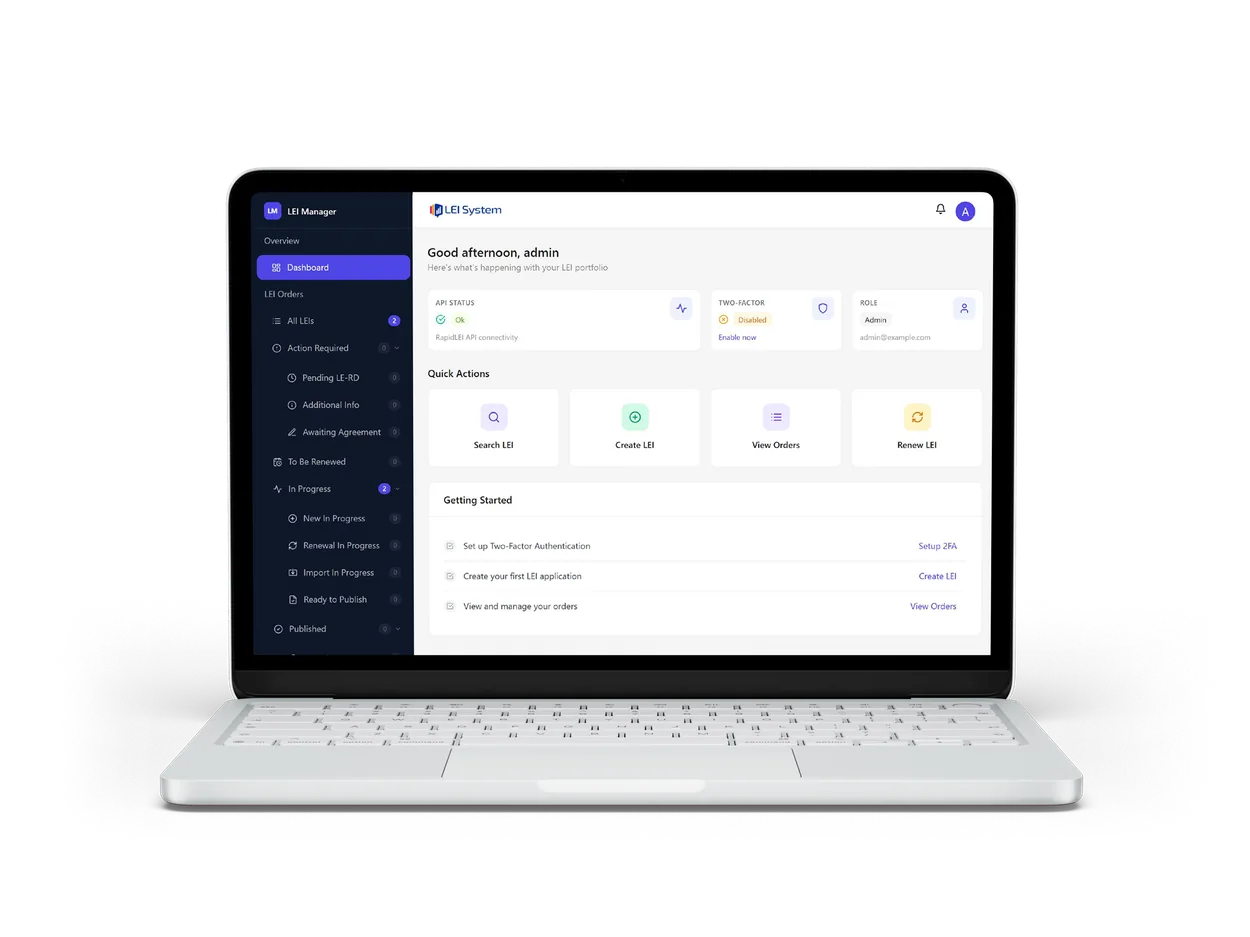
LEI Manager is LEI System's platform for exactly that.
Explore LEI ManagerTrack every LEI you're responsible for, your own entity, institutional counterparties, token issuers, from one dashboard, with automatic renewal so no code lapses mid-relationship.
Connect LEI registration, lookup and status checks directly into onboarding or transfer-processing systems via the LEI Manager API, so entity verification happens automatically as part of Travel Rule workflows.
Register up to 200 counterparty or subsidiary entities in a single upload instead of repeating the application 200 times, LEI Manager verifies each one against official registries and issues codes without separate validation delays.
Getting registered is a five-minute online process, not a paperwork exercise. Submit your entity's legal name and registration details, LEI System verifies them against official business registries, and your code is issued and published to the GLEIF Global LEI Index, immediately checkable by any counterparty or regulator who looks it up.

Pick a subscription plan and complete the online application with your entity's legal name, address and registration number.


Our system verifies your entity data against official business registries in real time, notifying if additional documents are needed.

Your LEI code is issued, recorded in the Global LEI Index and delivered to your email address along with a confirmation.
Every LEI System plan includes the GLEIF fee, lapse protection, and automatic annual renewal, so a code stays in ISSUED status for every transaction it is used in, not just the first one.

Kristian Hein, November 18
The Financial Stability Board’s 2026 cross-border payments report highlights the UK’s CHAPS system as a live example of how Legal Entity Identifiers are moving into payment infrastructure. CHAPS handles everything from time-sensitive business and property payments to large financial-market settlements. Its financial-institution layer carries 73% of the value settled, making LEI data especially relevant for risk management, compliance, counterparty identification, and automated processing.
Read more
Kristian Hein, November 11
Does a branch need its own LEI, or should it use the head office’s code? Opening a foreign branch does not automatically create a separate LEI requirement. This guide explains the difference between branches and subsidiaries, when reporting rules call for the head office’s LEI, and when a branch may need its own. Find out what to check with your bank, broker or supervisory authority before applying.
Read more
Kristian Hein, November 2
GLEIF and DirectTrust are developing a new digital trust model for US healthcare using LEI and vLEI. The initiative aims to help hospitals, laboratories, insurers, and other organizations verify identities, confirm delegated authority, and establish trust across digital systems. It marks an important step toward expanding the use of LEI beyond financial services.
Read more








 Affordable
 Lapse Guard
 Auto Renewals
 €59 total